The ET Equation: Choosing Second-Hand Alloys That Fit Your Car, Your Arches and Your Insurer

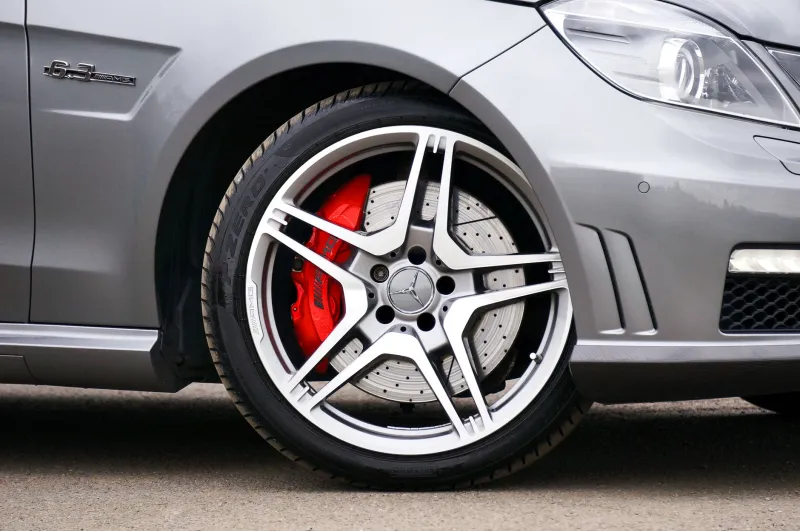
Photo by Photo by Othniel Dickson on Unsplash on Unsplash
Offset in plain English
Wheel offset, usually stamped as ET, is the distance in millimetres from the wheel's centreline to its mounting face. Think of it as the wheel's parking position relative to the hub. A high positive offset tucks the wheel further inboard. A lower offset, or a negative one, pushes it out towards the arch. That is why two 17-inch alloys of the same width can sit completely differently on the same car.
For a 7J wheel, the rim is about 178mm wide, so the centreline sits roughly 89mm from either edge. If you measure from the inner rim edge to the mounting face and get 140mm, the offset is about 51mm positive, or ET51. Simple arithmetic, but the consequences are not always simple. Offset changes where the tyre's contact patch sits, how the steering feels and how much space you have between rubber and suspension.
Why a few millimetres matter
A 10mm change in offset does not sound like much. On a Cornish B-road, it can be the difference between a car that tracks cleanly and one that follows every camber and repair patch. Pushing the wheel outward widens the track, which can look great, but it also alters scrub radius. That is the imaginary point where the steering axis meets the road. Move it too far and you can introduce tramlining, vague steering, kickback through the wheel and extra load on wheel bearings and suspension components.
Arch clearance is the other obvious issue. The outer edge of the tyre gets closer to the lip, especially under compression, on full lock or with a boot full of camping gear. Inner clearance matters too: struts, brake calipers, arch liners and suspension arms all occupy space. A second-hand set that looked fine on a lowered hatchback may not suit your standard-height estate.
Measure before you buy
Start with the stamp. Most alloys have a marking inside the spoke or on the hub face: something like 7Jx17 ET45, plus the PCD and centre bore. Photograph it before the seller gets twitchy. If the stamp is missing or painted over, measure the backspace. Lay the wheel face down, bridge a straight edge across the inner rim, then measure down to the mounting face. Subtract half the rim width in millimetres from that backspace and you have the offset.
Compare that figure with your car's original wheels. A small change may be fine. A jump of 15mm or more is where you need to be cautious, particularly if the new wheel is also wider. Online fitment calculators are useful for a sanity check, but they cannot see your brake calipers or the state of your arch liners. Treat them as a starting point, not a guarantee.
Test-fit properly
Never buy a set of alloys without a trial fit, even if the seller says they came off the same model. Jack the car up, fit one wheel with the tyre you intend to use and check the inner barrel against the strut and brake caliper. Lower the car, bounce each corner and turn the steering from lock to lock. Look for witness marks on arch liners, shiny patches on the inner wheel and any sign of the tyre shoulder polishing the arch lip.
Check wheel bolt engagement too. If the new wheels have a different mounting face thickness, your standard bolts may sit too shallow. Spigot rings are essential if the centre bore is larger than your hub; do not rely on the bolts to centre the wheel. After the first drive, re-torque the nuts at around 30 miles and recheck the arches with the car loaded.
Warning signs of an aggressive fitment
Rubbing is the obvious one, but it is not always noisy. Look for scuffed arch liners, polished inner wheel barrels and tyre shoulders with a grazed appearance. Tramlining on motorway ruts, a steering wheel that pulls over camber changes and vibration at speed can all point to offset and scrub radius issues. If the wheels poke beyond the bodywork, you may also be asking for attention from insurers and, depending on how the car is used, the police.
Bear in mind that spacers are not a magic fix. They change the effective offset and should be declared as a modification. Cheap universal spacers with poor hub location are a shortcut to vibration and stud failure.
MOT and insurance realities
An MOT does not test offset directly. It does check that wheels and tyres are secure, in suitable condition and not fouling the body, brakes or suspension. A wheel that rubs an arch liner or brake hose is a problem, and so is a tyre that is damaged or incorrectly seated. If an aggressive offset causes fouling or insecure mounting, the MOT can fail on the consequence even if the ET number never appears on the tester's sheet.
Insurance is the bigger issue. Alloy wheels are a modification. Some insurers treat a like-for-like replacement or a mild upgrade as cosmetic and charge little or nothing. Others will load the premium or decline cover. The dangerous move is not telling them. Non-disclosure can leave you with a void policy and a very expensive repair bill. Get a quote for the exact wheel and tyre specification before you commit.
Second-hand alloy checklist
- Check the ET, width, diameter, PCD and centre bore stamps.
- Compare the offset with your original wheels and be wary of big jumps.
- Inspect for cracks, buckles, corrosion and repaired kerb damage.
- Confirm the load rating is suitable for your car.
- Test-fit with the tyres you plan to use.
- Check inner and outer clearance on full lock and under load.
- Confirm bolt type, thread engagement and spigot ring needs.
- Ring your insurer with the exact specification before buying.
- Keep the receipt and declare the wheels if required.
- Re-torque after 30 miles and check for rubbing again.
Offset is one number, but it controls a lot. Get it right and a used set of alloys can sharpen the look and feel of the car. Get it wrong and you will be chasing vibrations, arch rub and awkward conversations with your insurer.