Sprung Money: Do Lighter Alloys Actually Pay Off on Cornish Back Roads?
Photo: Rolf Kranz, CC BY-SA 4.0, via Wikimedia Commons
Lighter wheels are the tuning world’s favourite free lunch. Every forum thread, every parts catalogue and every bloke with a set of scales in his garage will tell you the same thing: shave a few kilos from your alloys and the car will ride better, steer sweeter and even feel quicker. There’s truth in there. There’s also a fair bit of wishful thinking, a chunk of marketing gloss and, on a broken Cornish B-road, a very real chance you’ll spend good money to make your car worse.
Here at Tamar Wheels we like a lighter wheel as much as anyone. But “lighter” is not a magic word. Let’s weigh up what actually happens when you swap cast alloys for something fancier.
Unsprung mass: the simple bit
Unsprung mass is everything the springs don’t have to carry: wheels, tyres, brakes, hubs, a bit of suspension. Less of it means the suspension has an easier job keeping the tyre pressed into the road over bumps. On paper that’s a win for ride comfort and grip on rough surfaces.
On a smooth German autobahn, the difference can be subtle. On the A39 between Truro and Wadebridge, or the lanes around Tavistock, it’s more noticeable — but not always in the direction you expect. A lighter wheel can let the damper react faster, which is great if the damper is properly valved. Pair a featherweight alloy with tired standard suspension and you can end up with a busier, fizzier ride, because the wheel is now skipping over chatter rather than settling. Lightness amplifies whatever the rest of the chassis is doing.
Rotational inertia: the quote everyone repeats
The other half of the sales pitch is rotational inertia. Less mass at the outer edge of the wheel means less energy needed to spin it up, so acceleration and braking should improve. That’s real physics. Whether you’ll feel it is another matter.
Drop 2kg per corner and you might notice a slightly keener turn-in and a touch more eagerness under braking. Drop 500g per corner and you probably won’t, unless you’re the sort of driver who can feel a tyre pressure change of one psi. A lot of “lighter wheels transformed my car” reviews are really describing new tyres, fresh alignment or the placebo effect of spending money. The gains are real, but they’re rarely dramatic on a road car.
Forged versus cast: where the grams come from
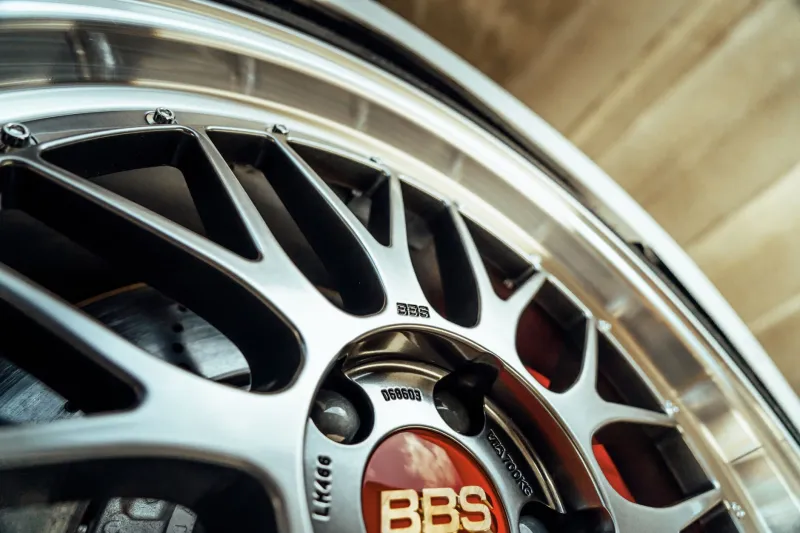
Most factory alloys and cheaper aftermarket wheels are cast. Molten aluminium is poured into a mould, and the result is decent, affordable and heavy-ish. Flow-formed wheels sit in the middle: cast, then spun to stretch the barrel, which saves weight without forged money. Forged wheels are hammered or pressed from a solid billet, giving a denser, stronger grain structure. You can make a forged wheel lighter for the same strength, or stronger for the same weight.
The price ladder is steep. A set of sensible cast alloys might cost £500–£800. Flow-formed can be £1,000–£1,500. Proper forged wheels often start around £2,000 and climb quickly. The weight saving between cast and forged might be 1–2kg per corner. That’s a lot of money per gram.
And here’s the catch: a cheap “lightweight” cast wheel can be light because there’s less metal in the spokes. That’s not engineering, it’s cost-cutting. The good stuff costs money because it keeps strength while removing mass.
The pothole paradox
Cornwall and Devon are not kind to wheels. We have frost heave, crumbling edges, farm slurry, stone walls and potholes that appear overnight like mushrooms. A lighter wheel with a thinner barrel and less material in the lip is often less resilient to a square-edged impact. Forged wheels can be both light and tough, but they can still bend. Cast wheels tend to crack or chunk. Neither is cheap to fix.
There’s also the sidewall question. If you go lighter by fitting a larger diameter wheel with a lower-profile tyre, you’ve just removed the cushion that was protecting the rim. The wheel may weigh less, but the tyre weighs more and the ride gets harsher. On broken B-roads, that’s a net loss for most drivers. A 17-inch flow-formed wheel with a sensible 50-profile tyre will often ride and survive better than a 19-inch forged wheel on rubber bands.
The insurance bit nobody wants to hear
Changing your wheels is a modification. Even if they’re the same size, even if they’re lighter, even if they’re “just OEM plus”. Your insurer needs to know. Some will treat a like-for-like alloy swap as a cosmetic change with little or no premium impact. Others will load the policy because the car is no longer standard. A few will decline to cover non-standard wheels entirely.
The bigger risk is the claim. If you bin it into a hedge and the assessor finds undeclared alloys, you could be looking at a reduced payout or a cancelled policy. That’s an expensive way to save a few kilos. Declare the change, get it in writing, and keep the standard wheels if you can — refitting them can sometimes reduce the premium or at least make a claim less complicated.
Where lightness stops paying
The break-even point is different for everyone, but a rough guide works. If you’re chasing lap times, competing in sprints or doing track days, lighter wheels make sense. The car is a toy, the roads are smooth and the gains are measurable.
For a daily driver on Cornish B-roads, the maths is less flattering. Spend £1,500 to save 6kg total and you might feel a small improvement in steering response. Spend the same money on good tyres, a proper alignment and fresh dampers and you’ll feel a much bigger difference everywhere. Lightness is a seasoning, not the meal.
The honest verdict
Lighter alloys aren’t a myth. They’re a real engineering choice with real trade-offs. The sweet spot for most UK drivers is a strong, reasonably light flow-formed wheel in a sensible size, wrapped in a tyre with enough sidewall to survive a Cornish winter. Forged wheels are lovely if the budget allows and the roads are kind. Cheap lightweight cast wheels are a gamble.
And whatever you fit, tell your insurer. The only thing worse than spending £2,000 on wheels is finding out they’re not covered after a pothole has rearranged your suspension.