Meet, Spin, Pay: A Collection-Day Checklist for Used Alloys Bought Online
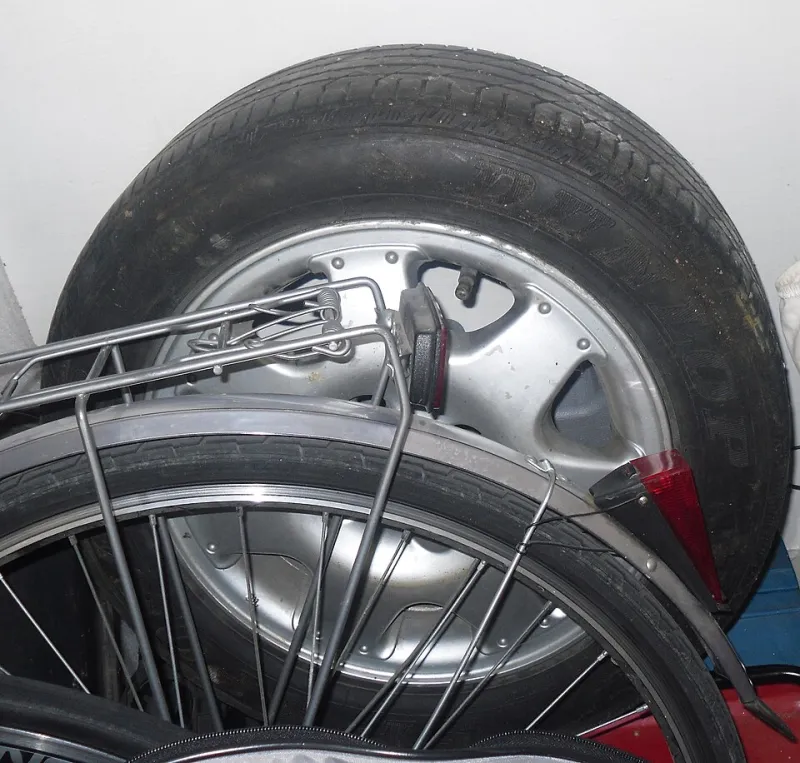
Photo: Alessandro Antonelli, CC BY 3.0, via Wikimedia Commons
Buying used wheels online has become a normal part of modifying a car. A set that cost someone two thousand pounds new turns up for four hundred, three counties away, described as 'mint, just a bit of kerb rash on one'. Sometimes that's true. Sometimes 'a bit of kerb rash' is filler, paint and a welded crack you won't find until the tyre goes soft at seventy.
You can't inspect a wheel through a phone screen. What you can do is turn collection day into a proper inspection, and walk away if it doesn't stack up. Here's the routine.
1. Get the stamps before you travel
Every reputable alloy has identifying marks cast or engraved on it — usually on the hub face or the back of a spoke. You want the part number, the width and diameter (often as 8J18 or similar), the offset as ET-something, the PCD, and the centre bore.
Ask the seller for clear photos of those stamps before you set off, then check them against your car's requirements and against each other. A set where three wheels share a part number and the fourth doesn't isn't a set, it's four wheels. That matters for offsets, brake clearance and resale.
While you're at it, confirm the load rating if it's stamped, and search the part number online. A quick lookup tells you what the wheel originally came off, which is often very different from what the seller claims.
2. Ask the awkward questions early
Has any wheel been welded? Has any been straightened? Are they freshly powder-coated? A fresh finish is the single best hiding place for a crack, and it's usually a sign someone is flipping rather than selling their own wheels. Not automatically bad — but you want the story before you see the shine.
Ask for a photo of each wheel's inner barrel and bead seat, not just the face. Ask whether the tyres (if included) hold pressure and what the date codes are. Ask if centre caps, spigot rings and bolts come with them, because replacing odd-sized caps can be a thirty-quid-each treasure hunt.
3. Bring the right kit
A torch, a small straight edge or steel rule, a soft blanket, and a mate. If you've got a magnetic pick or a small mirror, even better — inner barrels are dark and awkward. Cash is fine, but a bank transfer on the spot gives you a record and doesn't require finding a cashpoint in an unfamiliar town.
4. Inspect the faces first, then the barrels
Start with the obvious: kerb damage, scratches, lacquer peeling, and whiteworm creeping under diamond-cut finishes. None of that is fatal, but it's your negotiating position.
Then put the wheel face down on the blanket and get in the barrel with the torch. You're looking for hairline cracks radiating from the bead seat or between the spokes, and for any sign of welding — a rougher texture, a bead line, or paint that doesn't match. Run your thumb along the inner lip. You'll feel a buckle before you see it.
5. Spin them
If the seller will let you, mount each wheel on a balancing machine at a nearby tyre bay, or improvise: hold a straight edge against the rim edge while the wheel turns on a hub or a broom handle through the centre bore. A wobble in the lip means a buckle. A wobble in the face means something worse. This is the step people skip and regret.
6. Check the details that cost money later
- Bolt holes: look for ovalised or chewed seats — a sign of loose bolts or the wrong seat type being used.
- Centre bore: measure it. It should match your car or be reducible with spigot rings.
- Valve holes: check they're round and not cracked.
- Weight: if one wheel feels noticeably lighter than the rest, ask why.
- Tyres: if they're included, read the DOT codes. Anything over six or seven years old is scrap value, not a bonus.
- Matching dates: cast dates on the back of the spokes should be close together on a genuine set.
7. Guard against the obvious scams
Photographs lifted from an old forum build thread. A seller who can't do a viewing because 'the wheels are at my mate's'. A deposit request via a friends-and-family transfer. A price that's oddly low for a set that usually sells for double. Any one of those is a reason to slow down; two of them is a reason to walk.
Meet in daylight, in a public place, ideally with someone else. If the address keeps changing or the seller wants the money before you see the goods, thank them and move on. There'll be another set along next week.
8. Sort out transport before you buy
Four 18-inch alloys with tyres will not fit in the back of a hatchback with the seats up, and they're heavier than people expect — an alloy and tyre combo is often twenty kilos or more. Bring blankets or cardboard so you're not gouging your own trim, and a strap. If they're bare rims and there's any distance involved, a van hire for the afternoon can be cheaper than a chiropractor.
9. Get the paperwork
Write a receipt on the spot: date, seller's name, item description including part numbers, condition as agreed, price, and both signatures. Screenshot the listing and the messages. Keep the transfer reference. It takes two minutes and it's your only proof if the wheels turn out to have a problem, or if you're later asked where they came from.
10. Tell your insurer
New wheels are a modification, even if they're the same size as standard. Declare them, with the specification, before you fit them. It usually costs far less than people fear — and if you don't, you've handed your insurer a reason to walk away from a claim.
Get all ten steps done and you'll drive home with a bargain. Skip the barrel check and the spin, and you've bought a set of very expensive planters.